At the edge of the map, where the land unravels into wind and water, lies Patagonia—the bottom of the world. Here, the continent itself seems to lose its balance, tapering into islands and storms. Stretching across more than 400,000 square miles, this magnificent wilderness spans both Argentina and Chile, yet for all its size, it remains one of the most sparsely populated regions on Earth.
At Jenny’s Travel, we believe Patagonia represents the ultimate adventure for those seeking landscapes that defy imagination. From thundering glaciers to ancient forests, from penguin colonies to volcanic peaks, this is a land where nature rules absolutely and unapologetically.
Two Countries, One Wilderness
Patagonia offers two distinct personalities, divided by the Andes mountain range.
Chilean Patagonia to the west is a labyrinth of fjords and glaciers, where mountains sink into the sea, and temperate rainforests cling to steep cliffs.
Argentine Patagonia to the east unfolds in open plains, salt lakes, and dramatic cliffs where the land feels infinite.
Even now, in the 21st century, Patagonia still feels like a frontier—a place where the modern world fades, and the wilderness takes over.
Tierra del Fuego: The Land of Fire
As the continent narrows toward its southernmost point, the land breaks apart into a stunning archipelago known as Tierra del Fuego—the Land of Fire. The name feels almost ironic, because down here there’s not much fire, only ice, water, and an endless wind that never seems to rest.
The name came from the first Europeans who sailed past these shores. Ferdinand Magellan’s expedition in 1520 saw countless flickering lights along the coast—fires lit by the indigenous peoples who lived here—and thus christened this remote land.
Ushuaia: The End of the World
Among the twisted beech forests and windswept grasslands sits Ushuaia, the last city before the end of the world. It began as an outpost in the late 1800s, built by Anglican missionaries. Later, it became a penal colony—Argentina’s answer to Siberia. The government believed that prisoners sent this far south would never try to escape. They were right. The land itself was the prison.
Today, what was once exile has turned into attraction. The old prison became a museum, the docks filled with fishing boats and expedition vessels. The end of the world became a destination.
The Beagle Channel: Darwin’s Waterway
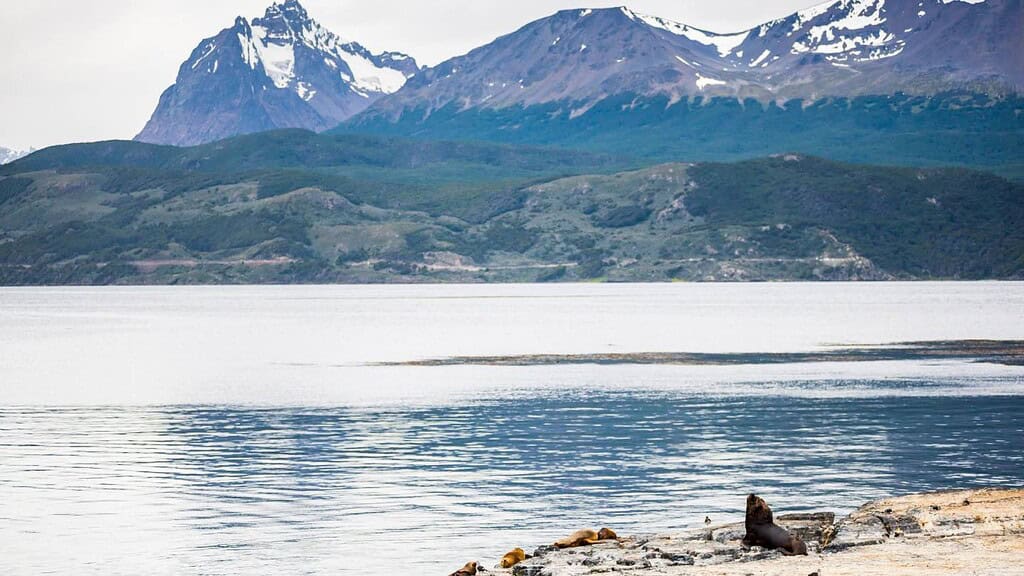
If Ushuaia is the heart of this world’s end, then the Beagle Channel is its bloodstream. This long, cold passage between Argentina and Chile stretches along the southern edge of Tierra del Fuego, taking its name from HMS Beagle—the ship that carried a young Charles Darwin through these waters in the 1830s.
Running approximately 150 miles from east to west, the channel connects the Atlantic and Pacific through a maze of islands and coves. Small boats navigate around rocky outcrops crowded with sea lions, their sleek bodies glistening in the weak sun as they bark and fight for space, unbothered by passing vessels.
Les Eclaireurs Lighthouse
In the middle of the channel, a lonely lighthouse stands on a rocky outcrop, roughly five nautical miles east of Ushuaia. Les Eclaireurs—”the scouts” in French—was put into service in 1920. The tower rises around 36 feet high, painted in red and white bands. Its light flashes every 10 seconds and is visible for roughly seven nautical miles on clear nights.
Often mistaken for the mythical “lighthouse at the end of the world” made famous by Jules Verne’s 1905 novel, it remains one of Patagonia’s most photographed landmarks. (The lighthouse that actually inspired Verne stands much further east, on Isla de los Estados.)
Penguin Encounters
Patagonia offers some of the world’s most remarkable penguin colonies, where thousands of these charismatic birds waddle ashore each year.
Isla Martillo
At the far end of the Beagle Channel, Martillo Island hosts one of the southernmost penguin colonies on Earth. Every October, when the austral spring begins, thousands of Magellanic penguins arrive to nest. Over time, Gentoo penguins and even the occasional King penguin have joined them—a living sign of how Patagonia’s ecosystem keeps shifting.
Isla Magdalena
Further north, in the Strait of Magellan, lies Isla Magdalena—a true penguin metropolis. If Martillo is an intimate family gathering, Magdalena is a bustling city. During the breeding season, the island hosts around 60,000 breeding pairs of Magellanic penguins. There are no enclosures or barriers, just a marked trail cutting through one of the densest penguin colonies on Earth.
Cape Horn and the Drake Passage
Leaving the Beagle Channel, calm waters give way to the Drake Passage, one of the world’s roughest stretches of ocean, famous for strong winds and ever-changing weather. Among the swells, the dark silhouette of Cape Horn rises from the water.
The first recorded rounding of Cape Horn was by the Dutch navigators Willem Schouten and Jacob Le Maire in 1616, who named it “Kaap Hoorn” after Schouten’s home town in the Netherlands. For the centuries that followed, Cape Horn became an essential—and notoriously dangerous—passage for trade ships, until the opening of the Panama Canal in 1914 made the route largely unnecessary. Even today, the cape maintains its reputation as a graveyard of ships.
Torres del Paine National Park
Leaving the coast and heading inland, we arrive at one of South America’s most spectacular wilderness areas: Torres del Paine National Park.
The name Paine comes from the Tehuelche word for “blue,” and everything here seems to carry that colour—the lakes, the mountains, even the shadows. At its centre rise the park’s most famous features: the Torres del Paine and the Cuernos del Paine—massive rock formations sculpted by ice over millions of years.
The Torres, three vertical granite spires reaching towards 2,500 metres (over 8,000 feet), are often shrouded in fast-moving clouds. The weather shifts constantly—rain, snow, and sunlight can all happen within an hour. But that volatility is part of its character. Torres del Paine doesn’t promise comfort; it promises perspective.
The Cave of the Mylodon
At the foot of the mountains lies one of Patagonia’s strangest places—the Cave of the Mylodon. This space has been occupied for thousands of years, first by prehistoric animals, later by the humans who hunted them.
The cave was made famous in the 1890s when a settler discovered a piece of strange, furry hide preserved by the cold air. It belonged to a Mylodon, an extinct giant ground sloth that once roamed Southern Patagonia. The discovery sparked worldwide fascination and turned the cave into a time capsule of a world that existed before glaciers fully receded.
Perito Moreno Glacier
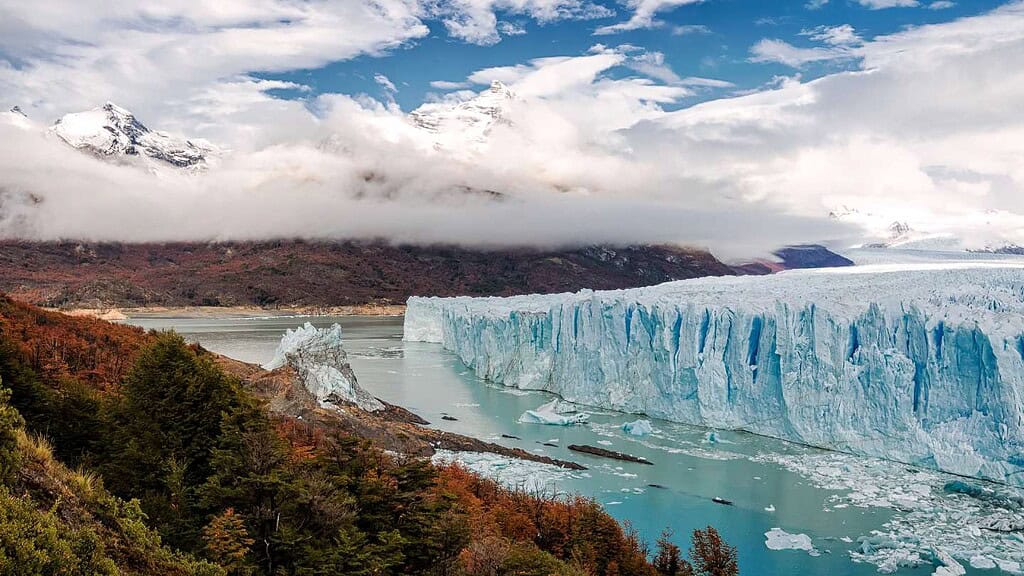
Just outside the town of El Calafate lies one of Patagonia’s most iconic spectacles: the Perito Moreno Glacier. Unlike most glaciers, which are quietly retreating, Perito Moreno has long been celebrated for holding its ground—advancing, calving, and cracking in a near-constant cycle.
The glacier covers roughly 250 square kilometres (about 100 square miles), but it’s the front wall—rising up to around 70 metres (some 240 feet) above the waterline—that commands attention. From the observation decks, the ice looks impossibly blue, a colour so pure it seems unreal.
Every few minutes, the glacier groans, and a piece collapses into Lago Argentino with a thunderous splash that echoes across the mountains. There’s a rhythm to it—a breathing force of nature. Deep fissures carve the ice into jagged towers, whilst small caves reveal walls of perfect azure.
The name Calafate comes from a hardy Patagonian shrub that bears dark blueberries. Local legend says that anyone who eats the fruit is destined to return to Patagonia. Perhaps that’s why travellers keep coming back.
Mount Fitz Roy and El Chaltén
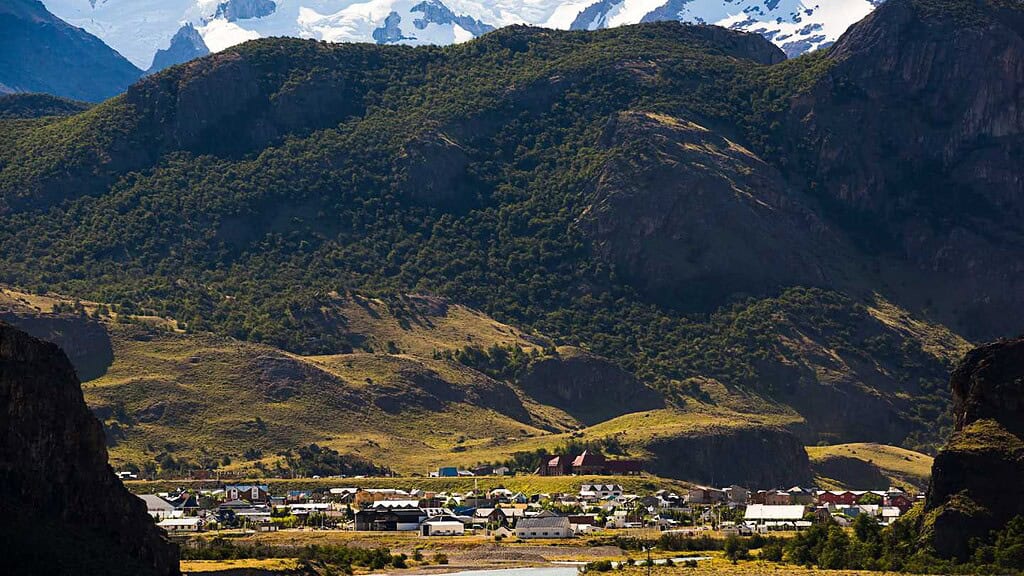
A few hours north of El Calafate, we meet one of Patagonia’s most recognisable silhouettes: Mount Fitz Roy. At its foot hides El Chaltén, Argentina’s trekking capital.
The Tehuelche people once called this peak “the smoking mountain”—not because it’s volcanic, but because the summit is so often wrapped in its own private cloud. At over 11,000 feet, it’s not the tallest in the Andes, but few mountains command the same reverence.
The weather changes in minutes here. Fitz Roy decides when it will show itself, and most days it doesn’t. But when the clouds finally part and the serrated skyline glows against a cobalt sky, every blister and every gust of wind feels worth it.
Cueva de las Manos: Ancient Handprints
Further from the Andes, in the desolate expanse of the Argentine steppe, lies one of the oldest human expressions on Earth: Cueva de las Manos (Cave of the Hands).
Hundreds of hands—red, white, black, and ochre—spread across the walls, layered one over another. They’re small and delicate, and the oldest of them have been here for many thousands of years.
Using mineral pigments and hollow bones, ancient peoples blew paint around their hands, leaving behind stencils that feel more human than any sculpture or monument. Each hand is both anonymous and deeply personal—a signature, a declaration: “We were here.”
The Marble Caves of Lago General Carrera
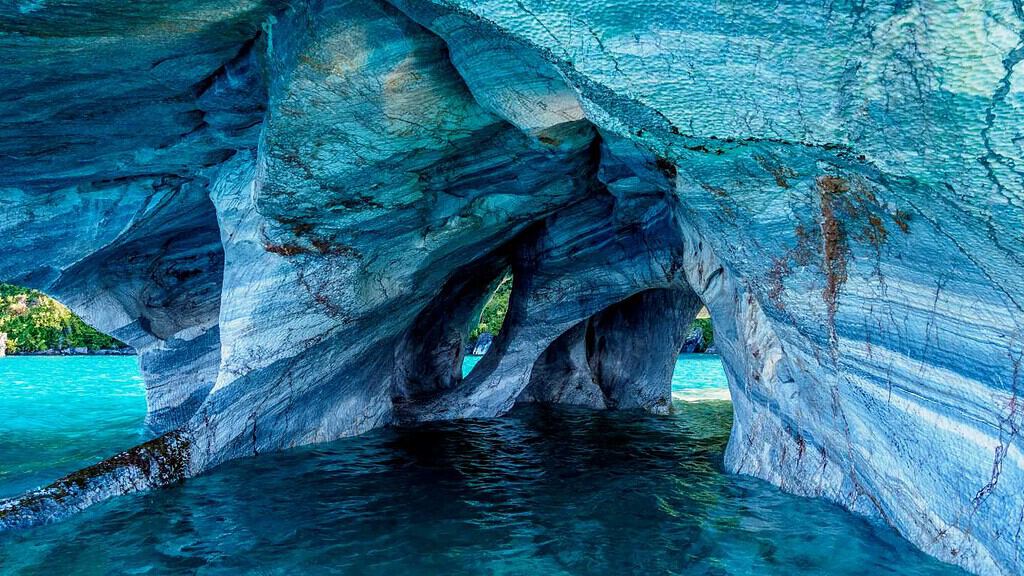
Lago General Carrera is the largest lake in Chile and the second largest in South America. Its waters are so vividly blue they seem lit from within. But along its shore lies a secret: the Marble Caves.
Sculpted by waves over thousands of years, these smooth corridors, columns, and domes of swirling blue and white stone are simply breathtaking. The walls are streaked and polished, glowing softly as sunlight filters through the turquoise lake outside.
On calm days, the reflections are mirrored perfectly in the lake’s surface, creating the illusion of floating through an endless blue sphere. It feels more like art than geology.
The Argentine Lake District
Northern Patagonia reveals a different character—a blend of Alpine charm and Andean grandeur.
San Carlos de Bariloche
Bariloche sits at the heart of Argentina’s Lake District, surrounded by peaks that rise directly from the water. Shaped in the early 1900s by European settlers, it grew into “the Argentine Switzerland,” with Alpine-style chalets and chocolate shops blending with Patagonian scale.
The Circuito Chico, a loop of roughly 37 miles, climbs into the hills west of town, winding through forests and passing hidden bays. Viewpoints offer sweeping panoramas of blue lakes and snow-capped peaks stretching all the way to Chile.
Lago Nahuel Huapi
Lago Nahuel Huapi, the immense glacial heart of northern Patagonia, sprawls over 60 miles in length. Its waters are startlingly clear—sometimes turquoise, sometimes navy, depending on the light.
The name comes from the Mapuche language, commonly translated as “Island of the Jaguar.” Beneath the surface lies great depth, and with it the stories of Nahuelito, Patagonia’s own cousin of the Loch Ness Monster. Most locals tell the story with a grin, but some of them still leave room for wonder.
The Road of the Seven Lakes
One of South America’s most celebrated drives, the Road of the Seven Lakes connects Villa La Angostura to San Martín de los Andes through a landscape of constant wonder. Mountains soften into rounded ridges, and rivers of turquoise water cut through valleys.
The route traces an old path once used by Mapuche communities moving between valleys. Today, it’s a pilgrimage for travellers drawn by the idea of a place where the world still feels whole.
Volcanic Wonders
Patagonia sits along the Andean Volcanic Belt, where the slow collision of tectonic plates has created some of the world’s most dramatic peaks.
Lanín Volcano
Lanín Volcano rises over 12,000 feet—a frozen pyramid straddling the border between Argentina and Chile. To the Mapuche people, it’s a living spirit, home to the Pillán, the guardian of the natural world.
Villarrica Volcano
Unlike the sleeping Lanín, Villarrica is one of South America’s most active volcanoes. Its lava lake, sometimes exposed at the summit, glows like a molten heartbeat. The flanks are cloaked in forests, and glacial meltwater forms a web of turquoise lakes below.
Salto del Agrio
Deep in Argentina’s Neuquén Province, Salto del Agrio cascades through a canyon of ochre, red, and yellow walls stained by mineral-rich waters from the Copahue Volcano. The basalt formations are remnants of ancient lava flows, solidified into geometric patterns that seem almost otherworldly.
Wildlife of the Atlantic Coast
On the shores of Argentina’s Atlantic coast, Puerto Madryn and the Valdés Peninsula offer some of Patagonia’s most remarkable wildlife encounters.
Through the southern winter and spring, the calm waters around the peninsula fill with southern right whales—massive creatures that migrate to mate and give birth. Sometimes they appear remarkably close to shore, mothers and calves gliding slowly through the water.
The peninsula became a UNESCO World Heritage Site in 1999, recognised as one of the most important breeding grounds for the species on Earth.
Chiloé Island: A World Apart
Off the coast of southern Chile, Chiloé Island feels separate from the rest of the country, as if the ocean preserved not only the landscape but also a way of life.
The island is famous for its wooden churches—many of them now UNESCO-listed—blending European design with local carpentry. But Chiloé’s most iconic image is its palafitos: stilted houses built by fishermen who needed to live close to their boats. At high tide, they seem to float; when the water retreats, wooden stilts sink into the exposed mud.
When to Visit Patagonia
The best time to visit depends on what you wish to experience:
- November to March (austral summer): Ideal for hiking, wildlife watching, and glacier visits
- June to September (austral winter): Perfect for skiing and winter landscapes
- October and April: Shoulder seasons offering fewer crowds and dramatic seasonal changes
Start Planning Your Patagonian Adventure
Patagonia is not just a destination—it’s a transformation. From the thundering walls of Perito Moreno to the ancient handprints of Cueva de las Manos, from penguin colonies to volcanic hot springs, this is a land that stays with you long after you’ve returned home.
At Jenny’s Travel, we specialise in crafting unforgettable travel journeys tailored to your interests, fitness level, and travel style. Whether you dream of trekking beneath the towers of Fitz Roy, cruising the Beagle Channel, or simply soaking in the beauty of the Lake District, our expert consultants will handle every detail.
Ready to explore the edge of the world?
Contact Jenny’s Travel today and let us design your perfect Patagonian adventure.
- Call us: 012 347 8891
- WhatsApp: 066 297 0631
- Email us: ho******@*************co.za
- Visit our website: www.jennystravel.co.za
Your journey to the end of the world begins with Jenny’s Travel.